Author: Ethan Miller

  • How Gen Z Brits Are Reinventing the CV, and Whether Employers Are Actually Impressed

    How Gen Z Brits Are Reinventing the CV, and Whether Employers Are Actually Impressed

    The two-page Word document with a Times New Roman font and a politely worded cover letter? For a growing number of young Brits, that’s as retro as a fax machine. UK Gen Z job application trends in 2026 look radically different from anything recruiters were trained to handle, and honestly, the gap between what applicants are doing and what hiring managers expect is becoming genuinely fascinating to watch.

    Young UK jobseeker recording a video CV application, reflecting UK Gen Z job application trends 2026

    The traditional CV is losing its grip

    There’s nothing wrong with a well-structured CV, in theory. Chronological work history, a tidy personal statement, a skills section. Clean. Functional. Forgettable. The problem, as many Gen Z jobseekers will tell you, is that a standard CV gives almost no sense of who someone actually is or what they can do. When you’re 22 and your work history includes a Saturday job at Greggs and six months of freelance graphic design, a traditional format doesn’t exactly sing.

    So they’re experimenting. Wildly, sometimes. Brilliantly, occasionally. And recruiters are scrambling to keep up.

    Video applications and personal websites are going mainstream

    The most visible shift is the rise of the video portfolio. Young applicants, particularly those going for roles in creative industries, marketing, tech, and media, are sending short self-recorded videos alongside or instead of a written CV. Think 90 seconds of confident talking-to-camera, screen recordings of past projects, and edited clips that would look at home on a polished YouTube channel.

    Personal websites are growing fast too. A 2025 survey by Graduate Fog found that over a third of UK graduates had built some form of personal portfolio site before applying for jobs. Platforms like Notion, Webflow, and even Linktree-style pages are being used to host work samples, testimonials, and something approximating a personal brand. For designers, developers, and writers, this makes obvious sense. For a trainee accountant? That’s where it gets more interesting.

    AI-generated cover letters: the elephant in the room

    Let’s talk about the cover letter situation, because it’s a bit of a mess right now. A significant portion of young applicants are using AI tools to write, or at least heavily rewrite, their cover letters. The results vary enormously. At best, you get a polished, well-structured letter that actually hits the key points of the job description. At worst, you get something that sounds like it was written by a very enthusiastic robot who has never had a job.

    Recruiters are noticing. Several HR professionals speaking to the BBC in early 2026 noted that AI-generated letters often feel oddly identical in structure and phrasing, and that spotting them has become a bit of an occupational sport. Some hiring managers are now asking for a brief, unpolished voice note instead of a cover letter, just to see if there’s a real person behind the application.

    The irony is sharp. Young people are using AI to appear more professional, while recruiters are trying to strip away the polish to find authenticity. Something has to give.

    LinkedIn is being completely reimagined by younger users

    Gen Z’s relationship with LinkedIn is genuinely odd and quite entertaining. They treat it less like a professional directory and more like a cross between a personal blog and a confessional. Posts about rejections, mental health struggles during job searches, and raw accounts of bad interviews regularly rack up thousands of engagements. Whether that helps or hurts them with employers is debatable, but it’s a very different energy from the polished, achievement-heavy profiles that were the norm five years ago.

    Some young Brits are actively building audiences on LinkedIn before they even apply for roles, treating follower counts and engagement as a form of social proof. And in certain industries, it’s working. A mid-size Manchester-based digital agency recently told a trade publication that three of their last five hires came from candidates whose LinkedIn content they’d been following for months before a role even opened.

    What do UK recruiters actually think?

    The recruiter response to UK Gen Z job application trends in 2026 is split fairly neatly down the middle. Agencies and employers in creative, tech, and digital sectors are often enthusiastic. A video showing genuine personality and skill can absolutely cut through, and a well-built portfolio site signals initiative in a way a bullet-pointed CV simply can’t match.

    More traditional sectors, finance, law, the civil service, large FTSE 100 firms, are considerably more cautious. Many still require applications through standardised portals, and anything that deviates from the expected format risks being filtered out before a human ever sees it. The Department for Work and Pensions noted in its 2025 labour market overview that young people are experiencing higher application-to-interview conversion challenges than older cohorts, which suggests the format mismatch is causing real friction.

    Is any of this actually working?

    The short answer: sometimes, yes. The longer answer involves knowing your audience. A video portfolio sent to a law firm’s HR inbox is likely going straight to the bin. The same video sent to a content agency in Shoreditch might get you an immediate call. Context is everything, and the most successful young applicants seem to be the ones who’ve figured out how to code-switch between formats depending on who they’re applying to.

    What’s genuinely encouraging about UK Gen Z job application trends in 2026 is the creativity and self-awareness behind them. Young people who grew up making content, building websites for fun, and marketing themselves on social platforms are simply applying those skills to the job hunt. That’s not laziness or gimmickry. That’s adaptability.

    The sticking point is that the recruitment industry hasn’t fully caught up. Applicant tracking systems, the software that most large employers use to filter CVs, are not designed to process a Notion portfolio link or a 90-second intro video. Until the infrastructure changes, Gen Z will keep banging against a system that was built for a completely different generation’s habits.

    For recruiters willing to look past the format, there’s often something genuinely impressive waiting on the other side. For those who aren’t, they might just be filtering out the most capable applicants they’ll never meet.

  • The UK Airports Trialling Biometric Gates, and the Privacy Rows They’re Causing

    The UK Airports Trialling Biometric Gates, and the Privacy Rows They’re Causing

    Airports are strange places at the best of times. You hand over your passport, take your shoes off for no immediately obvious reason, and queue behind someone who apparently forgot they had a full bottle of shampoo in their hand luggage. Now, though, something genuinely new is happening at Heathrow and Manchester: UK airport biometric facial recognition gates are being trialled, and they are moving fast. The question is whether “fast” is the only thing that matters here.

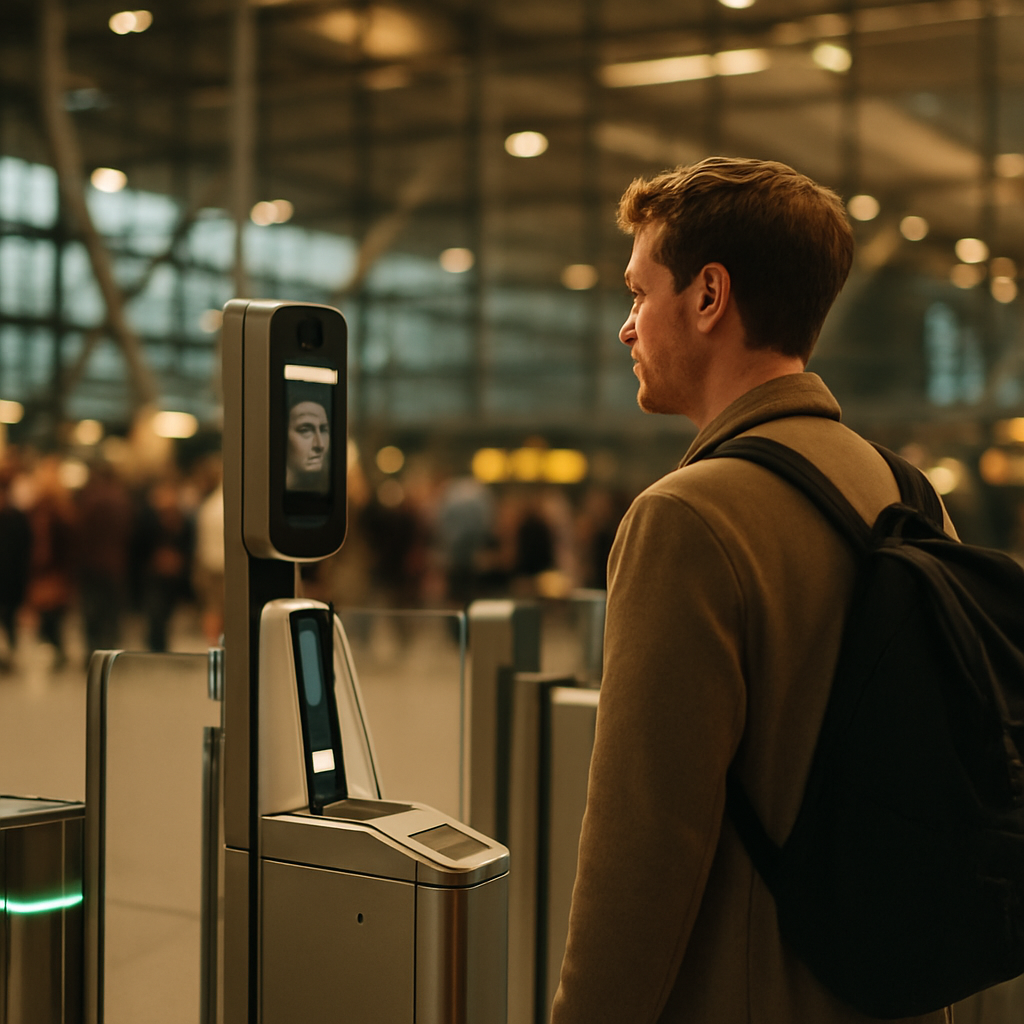
    The basic pitch is seductive. Walk up, look at a camera, walk through. No fumbling for a passport, no scrabbling around for a boarding pass, no awkward moment where the scanner decides your document is upside down. Trials at Heathrow Terminal 5 have reportedly cut individual boarding times to under ten seconds in controlled conditions. For airlines trying to get a 300-seat aircraft off the stand on time, that is genuinely meaningful. Manchester Airport has been running similar pilots through its newer self-service e-gates, and early passenger feedback has been, on the whole, pretty positive.

    Passenger using UK airport biometric facial recognition gate in a modern British terminal

    How does it actually work at the gate?

    The systems being tested match a live facial scan against a biometric template stored either on your passport chip or captured earlier during check-in. Your face becomes, in effect, your ticket. The camera grabs a quick image, the algorithm compares it against the stored template, a green light appears, and off you go. The whole thing happens in the background so smoothly that many passengers have reportedly not even clocked that they’ve just been through a biometric check.

    That last detail is where things get interesting, because “not noticing” is precisely the kind of passive consent that privacy campaigners find troubling. Big Brother Watch, one of the more vocal civil liberties organisations in the UK, has repeatedly raised concerns about the rollout of facial recognition in public spaces. Airports are not exactly a public square, but they are spaces where people cannot simply choose to go elsewhere if they object.

    What the ICO has said about passenger biometric data

    The Information Commissioner’s Office, the UK’s data watchdog, has been watching the spread of biometric systems across various sectors with visible wariness. Biometric data sits in a special legal category under UK GDPR: it is classified as sensitive personal data, which means collecting and processing it requires a lawful basis that goes beyond a standard consent tick-box. The ICO published guidance making clear that organisations using facial recognition in live public-facing contexts must demonstrate that it is strictly necessary, proportionate, and that robust safeguards are in place. You can read their current position on biometric data directly at ico.org.uk.

    The airports and their technology partners argue they do meet those thresholds. The facial template, they say, is deleted once you have boarded. No long-term database of passenger faces is being built. The data is used for one purpose, in one moment, and then it is gone. That is a fairly compelling technical argument. The sticking point is verification: how do passengers, or regulators, independently confirm that deletion is actually happening?

    The accuracy question nobody wants to answer directly

    Facial recognition accuracy is not a flat number. It varies depending on lighting, camera quality, the algorithm being used, and critically, the demographic of the person being scanned. Multiple academic studies and real-world deployments have shown higher error rates for people with darker skin tones, older faces, and women in certain conditions. The Metropolitan Police’s own use of live facial recognition has been the subject of sustained criticism on exactly these grounds.

    Airport operators have not been particularly forthcoming about publishing granular accuracy data broken down by demographic. That is understandable from a commercial confidentiality angle, but it does not sit comfortably alongside public assurances that the technology works well for everyone. If a gate wrongly rejects you five times at 6am before a long-haul flight, “it works most of the time” is cold comfort.

    There is also the question of what happens at the edges. Most trials have a human agent available to handle exceptions. But as systems scale and staff numbers are squeezed (as they perpetually are in the aviation industry), that human fallback may quietly erode. The system designed as a helpful shortcut can become the only route available.

    Could you opt out if you wanted to?

    Technically, yes, for now. Passengers at the current trial gates can request to be processed through a standard manual check. In practice, though, the path of least resistance is always the biometric gate, and airports are not exactly incentivised to advertise the alternative. As these gates move from trial to standard infrastructure, the opt-out option may become harder to find and socially more awkward to exercise. Standing in a separate queue while everyone else breezes through a camera is a mild form of pressure, but it is pressure nonetheless.

    There is a broader philosophical dimension here too. The normalisation of having your face scanned as a routine part of travel feels like a significant cultural shift. A generation of passengers who grow up expecting to look at a camera to board a plane may not question, or even register, that the same infrastructure could be used for other purposes by other actors in different contexts.

    Is faster boarding worth it?

    On a purely operational level, the efficiency case for UK airport biometric facial recognition is solid. Airlines lose enormous amounts of money to delays, and shaving time off boarding is one of the few levers airports can actually pull. Heathrow, handling around 80 million passengers a year, stands to gain significantly if its gates flow even marginally faster. The technology, deployed thoughtfully, genuinely could make flying less of a teeth-grinding experience.

    The campaigners are not wrong, though. The ICO is not wrong. The questions about demographic accuracy, genuine consent, data retention, and the creeping normalisation of biometric surveillance in everyday life deserve proper public debate rather than being quietly resolved in the background while everyone is distracted by Pret queues and duty-free perfume. Speed is great. Transparency would be better.

    What makes the UK airport biometric facial recognition story worth following is that it is one of those moments where a genuinely useful technology and legitimate civil liberties concerns collide head-on. The outcome of these trials will shape how millions of British passengers interact with airports for decades. That feels like it deserves a bit more scrutiny than it is currently getting.

  • Why British Weather Forecasting Is About to Get Dramatically More Accurate

    Why British Weather Forecasting Is About to Get Dramatically More Accurate

    British weather forecasting has always been something of a national sport. We moan about the inaccuracies, screenshot the wrong predictions, and smugly remind anyone who’ll listen that the BBC said it would be sunny. But something genuinely exciting is happening right now, and it’s about to make all of that banter a lot less justified.

    The Met Office has been quietly building one of the most powerful weather supercomputers on the planet, and its new partnerships with satellite data providers are changing the game entirely. Not in a vague, press-release kind of way. In a real, measurable, your-life-will-actually-be-different kind of way.

    Dramatic storm clouds over Exeter representing advances in British weather forecasting

    What the Met Office’s New Supercomputer Actually Does

    The Met Office’s latest supercomputing system, built in partnership with Microsoft and housed in Exeter, is capable of around 60 petaflops of processing power. That’s an almost unfathomable amount of number-crunching. To put it loosely, it can run vastly more complex atmospheric models, at finer spatial resolutions, and update them more frequently than was previously possible.

    Older forecasting models might divide the UK into grid squares of several kilometres each. The new system can work at resolutions closer to one kilometre or below, which means a storm rolling in off the Irish Sea can be tracked with much greater precision as it hits the Welsh coast, moves inland, and decides whether Manchester or Liverpool gets soaked first. If you’ve ever wondered why two towns ten miles apart can have wildly different conditions, this level of detail starts to actually address that.

    The supercomputer also allows ensemble forecasting to run at much greater scale. Instead of producing one prediction, the system generates dozens of slightly different scenarios based on varying starting conditions, then analyses the spread. A tight cluster of outcomes means high confidence. A wide spread means uncertainty. Forecasters can then communicate that nuance far more honestly than a single number ever could.

    Where Satellite Data Fits In

    Raw computing power alone doesn’t produce better forecasts. The data feeding those models matters just as much. This is where satellite partnerships become critical. The Met Office works closely with EUMETSAT, the European organisation for the exploitation of meteorological satellites, to ingest enormous volumes of atmospheric data covering temperature profiles, humidity, cloud structure, wind speeds at altitude, and sea surface temperatures.

    Modern weather satellites like the Meteosat Third Generation series can capture imagery at far higher frequencies and resolutions than previous generations. Combined with data from polar-orbiting satellites that sweep the whole planet, the models now have a richer, more current picture of the atmosphere to work with before they even begin calculating what’s coming next. The quality of a forecast is directly tied to the quality of data going in. Better satellites mean better inputs, which means fewer nasty surprises.

    It’s also worth noting that advances in Satellite Installation technology on the ground have made it easier to receive and process high-bandwidth satellite feeds quickly, which contributes to the overall speed of the data pipeline from orbit to forecast.

    High-performance supercomputing hardware used to power British weather forecasting models

    What This Means for Farmers

    British agriculture is weather-dependent in an extremely literal sense. Harvest windows, pesticide application schedules, soil preparation, livestock welfare decisions, all of them hinge on accurate short-range forecasts. A farmer in the Yorkshire Wolds or the Shropshire plains doesn’t just need to know it might rain on Thursday. They need to know whether rain arrives at 6am or 2pm, and whether the ground will be workable by the weekend.

    Improved kilometre-scale resolution forecasting, backed by better satellite data, gives farming communities exactly that kind of granularity. The Met Office already provides dedicated agricultural weather services, and better underlying models will sharpen those products significantly. According to the Met Office’s own agricultural forecasting pages, precision weather data can directly affect crop yield decisions and operational costs. That’s not abstract. That’s pounds in farmers’ pockets.

    Festival Season Is Going to Be More Interesting

    Glastonbury. TRNSMT. Latitude. Boardmasters. The UK festival calendar is packed, and organisers spend months planning logistics that can be derailed in hours by unexpected weather. Stage roofs, electrical safety, crowd flow, welfare tents, all of it changes dramatically when a flash flood warning lands at midnight on the Friday.

    Five-day forecasts have historically been patchy at best for the kind of fine detail that event management requires. With higher-resolution models running on the new supercomputer infrastructure, the accuracy of multi-day forecasts is genuinely improving. The difference between a confident 72-hour forecast and a vague one is the difference between a festival organiser deploying extra drainage equipment early or scrambling at the last minute. Better British weather forecasting doesn’t just help individuals. It saves organisers real money and keeps crowds safer.

    The Commuter Angle (Yes, Really)

    This might sound less glamorous than farms and festivals, but millions of people make daily decisions based on weather. Cycling to work, catching an earlier train before storms arrive, choosing whether the kids need wellies for the school run. The aggregated effect of more accurate short-range forecasts is enormous.

    Transport network operators, particularly those running rail services across exposed routes in Scotland and the north of England, use Met Office data to make decisions about speed restrictions, track inspections, and engineering work scheduling. A sharper forecast means fewer unnecessary delays and a better-targeted response when severe weather actually hits. Network Rail already has formal partnerships with the Met Office for exactly this purpose, and the improved modelling will feed directly into those operational systems.

    How Soon Will We Notice?

    The infrastructure upgrades are not a future project. The new supercomputing capability is already operational and being refined. Model updates are rolling out progressively, and verification data comparing the new forecasts to actual outcomes is accumulating. Meteorologists at the Met Office and in the academic community are already reporting meaningful improvements in the accuracy of five-day temperature and precipitation forecasts over the UK.

    For most people, the change will be subtle at first. Fewer embarrassingly wrong weekend forecasts. A bit more confidence in the five-day outlook. Gradually, the cultural habit of automatically distrusting British weather forecasts might actually start to shift. That would be quite something.

    British weather forecasting has spent decades as the butt of the joke. With the computing muscle and satellite data now in place, the Met Office is making a serious case that the punchline is running out of time.

    Frequently Asked Questions

    How accurate is the Met Office five-day forecast now?

    Five-day forecasts from the Met Office have improved substantially in recent years and continue to improve with new supercomputing infrastructure. Today’s five-day temperature forecast is broadly as accurate as a two-day forecast was in the 1980s, and that benchmark is being pushed further by higher-resolution modelling and better satellite data inputs.

    What supercomputer does the Met Office use?

    The Met Office’s latest supercomputing system is a Microsoft Azure-based high-performance computing environment, significantly expanding on its previous Cray-based systems. It is capable of around 60 petaflops of processing power, making it one of the most powerful weather forecasting systems in the world.

    Does satellite data actually improve weather forecasts?

    Yes, satellite data is one of the most critical inputs for modern weather forecasting. Satellites provide atmospheric temperature profiles, humidity measurements, cloud structure, and sea surface temperatures across the entire globe, giving models far more complete starting conditions. Better satellite data directly leads to more accurate forecast output.

    How does British weather forecasting compare to other countries?

    The Met Office is widely regarded as one of the world’s leading national weather services and consistently ranks among the top performers in international forecast accuracy comparisons. Its combination of dedicated research, long-term satellite partnerships through EUMETSAT, and significant computing investment keeps it competitive with the European Centre for Medium-Range Weather Forecasts.

  • Britain’s Most Mysterious Abandoned Websites and the Communities Still Keeping Them Alive

    Britain’s Most Mysterious Abandoned Websites and the Communities Still Keeping Them Alive

    There is something genuinely eerie about stumbling across a forum post from 2003 and realising the person who wrote it might still be checking back for replies. Forgotten British web communities are a peculiar phenomenon. They are dusty, often broken, sometimes held together with what feels like digital string and good intentions, and yet people are still in them. Chatting. Posting. Existing. The British web of the late 1990s and early 2000s had a character all of its own, and bits of it, remarkably, are still ticking.

    This is not a sad story. Or rather, it is, but in the best possible way. Think of it like finding an old corner pub that somehow dodged every redevelopment, still serving the same regulars, still with the same hand-painted sign. Warm, odd, a little out of time. That is exactly what some of these places feel like.

    Close-up of an old forum layout representing forgotten British web communities from the GeoCities era

    The GeoCities Graveyard and Its British Survivors

    GeoCities shut down its international operations in 2009, which was a bit like demolishing an entire town of homemade houses overnight. Thousands of UK-based personal pages vanished. Britpop fan shrines, Doctor Who theory pages written in Comic Sans, football manager stat archives, local ghost-hunting clubs from Wolverhampton and Wakefield. Gone. Well, mostly gone.

    Archive.org’s Wayback Machine caught a remarkable number of them. Volunteers have spent years crawling through the wreckage, and a project called documented by the BBC helped shine a light on just how much cultural history was almost permanently lost. British fan sites from that era were strikingly personal. No algorithms to game, no follower counts to chase. Someone just really, really loved Buffy the Vampire Slayer or the band Embrace, and they built a page about it using a free tutorial they found somewhere on Lycos.

    The ones that survived tended to have one thing in common: a community that gave them a reason to keep the lights on.

    Forums That Refused to Die

    British internet forums from the early 2000s occupy a strange middle ground. They are too niche for mainstream attention, too beloved to be switched off. Take the world of UK car enthusiasts. Forums built around specific makes and models, particularly older ones, Fords from the 1980s, classic Minis, early Vauxhall Astras, still see regular posts. Owners need each other. Parts are hard to find, knowledge is scarce, and the forum thread from 2007 explaining how to fix a specific gearbox fault is still the best resource available anywhere.

    The same pattern repeats across dozens of niches. UK railway enthusiast boards. Local history discussion groups anchored to specific towns. British science fiction fan sites that predate Reddit by a decade. They persist because the information they contain is irreplaceable, and the regulars genuinely like each other after fifteen-odd years of posting.

    Some of these forgotten British web communities have an average post age that reads like a geological timeline. A reply from April 2009, then silence for three years, then a new member in 2013, then more silence, then a flurry of activity in 2021 when someone found the site via a Google search and could not believe it still worked.

    The Strangely Active Ones

    A few British portals from the early web era are not just surviving. They are genuinely, actively, confusingly busy. Pistonheads is the obvious big name, launched in 1999 and still pulling serious traffic for car content. But the more interesting cases are smaller. Boards dedicated to UK allotment gardening that still post seed-swap threads. British metal detecting communities where users share finds from fields in Norfolk and Shropshire. Knitting forums from 2001 that somehow got a second wind when lockdown hit in 2020 and a new generation discovered they had been there all along.

    There is even a small subset of what you might loosely call interest-based communities that blur into something more political. Somewhere between a passionate hobbyist forum and a genuine campaigning space, overlapping with the kind of energy you find on activist websites where people organise around shared causes. The British web has always had that streak of grassroots stubbornness in it.

    The strangest cases are the portals that appear frozen in time visually but have active back-ends. You load the page, the layout is pure 2004, animated GIFs and all, but the latest post is from this morning. It is disconcerting in the best way. Like a time machine someone left running.

    Why Do People Stay?

    It is a fair question. Social media exists. Reddit exists. Discord exists. Why would anyone still prefer a forum that looks like it was designed on Windows XP?

    The answer is usually some combination of familiarity, trust, and data ownership. The regulars on these old forums know each other. They have been through bereavements together, celebrated promotions, watched each other’s children grow up through occasional mentions in posts. Moving to a shiny new platform would mean leaving all of that context behind, and often losing the archive of posts that represents genuine collective knowledge built up over years.

    There is also a quiet suspicion of modern platforms among older UK internet users. Data harvesting, algorithmic timelines, content moderation that feels inconsistent. An old PHP forum owned by a bloke in Nottingham who has been paying the hosting bill since 2002 starts to look quite appealing by comparison.

    Preserving the Old British Web Before It Really Does Disappear

    The clock is ticking, though. Hosting bills get forgotten. Domain renewals lapse. The person who has been quietly keeping a community alive suffers a health crisis or simply decides enough is enough. When that happens, decades of posts, photographs, local knowledge and genuine friendship vanish in an afternoon.

    Groups like the Digital Preservation Coalition, based in the UK, are working on exactly this problem at an institutional level. Individual volunteers do their bit too, archiving sites before they go dark, petitioning hosting companies for grace periods, migrating content to Archive.org before the window closes.

    If you have spent any time on an old British forum, it is probably worth taking a screenshot or two. Not for nostalgia’s sake exactly, but because these forgotten British web communities are primary sources. They document how ordinary British people talked, thought, and connected with each other during one of the strangest and most transformative periods in recent history. That is worth more than it might look at first glance.

    Go find an old British forum tonight. Scroll back to the early pages. Read what people were excited about in 2004. It is, I promise, one of the more unexpectedly moving things you can do on the internet right now.

  • AI Companions Are Getting Weird (And Honestly, Kind of Brilliant)

    AI Companions Are Getting Weird (And Honestly, Kind of Brilliant)

    Something genuinely strange is happening with AI companions, and I mean that in the best possible way. A few years ago, talking to a chatbot felt like arguing with a vending machine. Now? People are forming real emotional connections with AI entities, booking time to “chat” with them like they’d schedule a coffee with a mate, and researchers are scrambling to figure out whether any of this is actually good for us. Spoiler: nobody fully knows yet, which makes it even more interesting.

    Woman using an AI companion app on her phone in a cosy UK flat

    So What Are AI Companions, Exactly?

    AI companions are apps, platforms, or devices built around the idea that artificial intelligence can provide genuine social and emotional value. Not just answering questions, but listening, remembering, responding with something that feels like warmth. The big names right now include Replika, Character.AI, and a growing cluster of newer entrants targeting specific niches: grief support, loneliness in older adults, social anxiety practice. Some feel like chatting with a friendly robot. Others are frankly uncanny.

    In the UK, the market is moving quickly. Mental health pressures are real and well-documented, NHS waiting lists for therapy remain stubbornly long, and a younger generation that grew up typing their feelings into Discord doesn’t find the idea of an AI friend particularly weird. The BBC’s technology desk has been tracking the space closely, noting how companion apps saw a significant spike in downloads across British app stores throughout 2025, particularly among 18 to 34 year olds.

    Why People Actually Use Them (The Honest Answer)

    Forget the sci-fi framing for a second. Most people using AI companions aren’t delusional or desperately isolated. They’re using them for the same reason they might journal, or talk to a dog, or ring a parent late at night. It’s low-stakes connection. There’s no judgment. The AI doesn’t get tired, doesn’t check its phone mid-sentence, and doesn’t bring its own drama to the conversation.

    For people with social anxiety, that’s actually useful. Practising small talk with an AI before a job interview or a first date sounds a bit daft until you realise it works for a lot of people in the same way that rehearsing in front of a mirror does. Less embarrassing, more interactive. Some therapists in the UK are cautiously endorsing companion apps as a supplement to proper treatment, though the word “supplement” is doing a lot of heavy lifting there.

    The Tech Behind the Emotional Warmth

    What makes modern AI companions feel different from older chatbots is the combination of large language models and persistent memory. The AI remembers that your sister is called Priya, that you had a rubbish Monday, that you’re allergic to mushrooms. That continuity creates something that mimics a relationship arc. It’s not magic. It’s pattern matching and token prediction at staggering scale. But the output? It really does feel different.

    Character.AI lets users create or interact with custom personas, and the platform has some genuinely wild offerings. You can chat with a version of a historical figure, a fictional character, or something entirely original built by another user. It’s part creative writing sandbox, part social experiment, part something that doesn’t have a name yet. The numbers are eye-watering: Character.AI reportedly clocked more average time-per-user than most social media platforms at various points in 2025.

    Replika takes a more personal companion angle. It remembers birthdays, asks how you slept, remembers grudges you mentioned three weeks ago. It’s the digital equivalent of a friend who actually pays attention, which is both endearing and, depending on your mood, slightly unsettling.

    The Ethical Headaches Nobody Has Solved

    Here’s where it gets properly complicated. If someone forms a strong emotional dependency on an AI companion, and the company decides to change the personality, monetise certain responses, or shut down entirely, that person experiences something very close to loss. Replika actually tested this in early 2023 when it modified certain relationship features, and the backlash was raw and loud. People were genuinely upset in ways that surprised even the most sympathetic observers.

    The ICO, the UK’s data regulator, is watching this space carefully. Personal conversations with AI companions are extraordinarily intimate. The data those conversations generate is extraordinarily valuable. How it’s stored, who can access it, whether it could ever be used in ways users didn’t consent to: these are live questions with no clean answers yet. Any UK-based user of these platforms would do well to actually read the privacy policy, painful as that sounds.

    There’s also a bigger question about what happens to human relationships if frictionless AI connection gets good enough. The friction in human friendships, the scheduling, the compromise, the patience required, is arguably what gives them meaning. An AI companion never cancels on you. But is that a feature or a loss?

    What’s Coming Next in the AI Companion Space

    Hardware is the next frontier. Several companies are working on physical AI companion devices, small robots or wearable tech that provide voice-based companionship in the real world rather than through a screen. Japan has been experimenting with this for years in elder care, and UK trials are beginning to appear in care homes and sheltered housing schemes. The early results are more positive than the sceptics expected.

    Multimodal companions, ones that can see, hear, and respond to facial expressions via a camera, are also in development at several labs. The idea that an AI could notice you look tired and respond to that, without you having to type it, edges the experience much closer to genuine social interaction. Whether that’s exciting or deeply strange probably depends entirely on your personality.

    My take? AI companions are real, they’re growing fast, and they’re filling gaps that genuinely exist in people’s lives. The technology isn’t the problem. The business models, the data practices, and the lack of clear regulation are the things worth keeping a close eye on. The conversations people are having with these systems are sometimes funny, sometimes touching, and occasionally a bit heartbreaking. Which is, when you think about it, pretty much the same as any other kind of conversation.