

Walk past your local Oxfam on a Saturday morning and you’d be forgiven for thinking nothing much has changed. Racks of slightly musty knitwear, towers of paperbacks, a glazed volunteer pricing up a bread maker. But behind the scenes? Things have got genuinely interesting. UK charity shops selling online in 2026 are quietly generating millions, using tools and platforms that would have sounded laughably futuristic ten years ago. AI pricing algorithms, Vinted storefronts, eBay listings photographed on proper lightboxes. This is not your nan’s jumble sale.
The numbers are actually staggering
Charity retail in the UK is enormous. The Charity Retail Association estimates that Britain’s charity shops generate over £400 million in annual income for good causes, and a growing chunk of that is coming from online channels rather than the shop floor. Oxfam alone runs one of the UK’s biggest charity eBay operations, shifting everything from vintage leather jackets to first-edition novels through its dedicated online hub. In 2025, the organisation reported that its online sales had grown by double digits year on year, driven partly by a more systematic approach to identifying high-value donations before they ever hit the rail.
What changed? Partly it’s just the internet getting older and more embedded in how people shop. But it’s also charity organisations finally investing in proper digital infrastructure instead of bolting a PayPal button onto a 2009 website and hoping for the best.
Oxfam’s AI pricing tools are the real story here
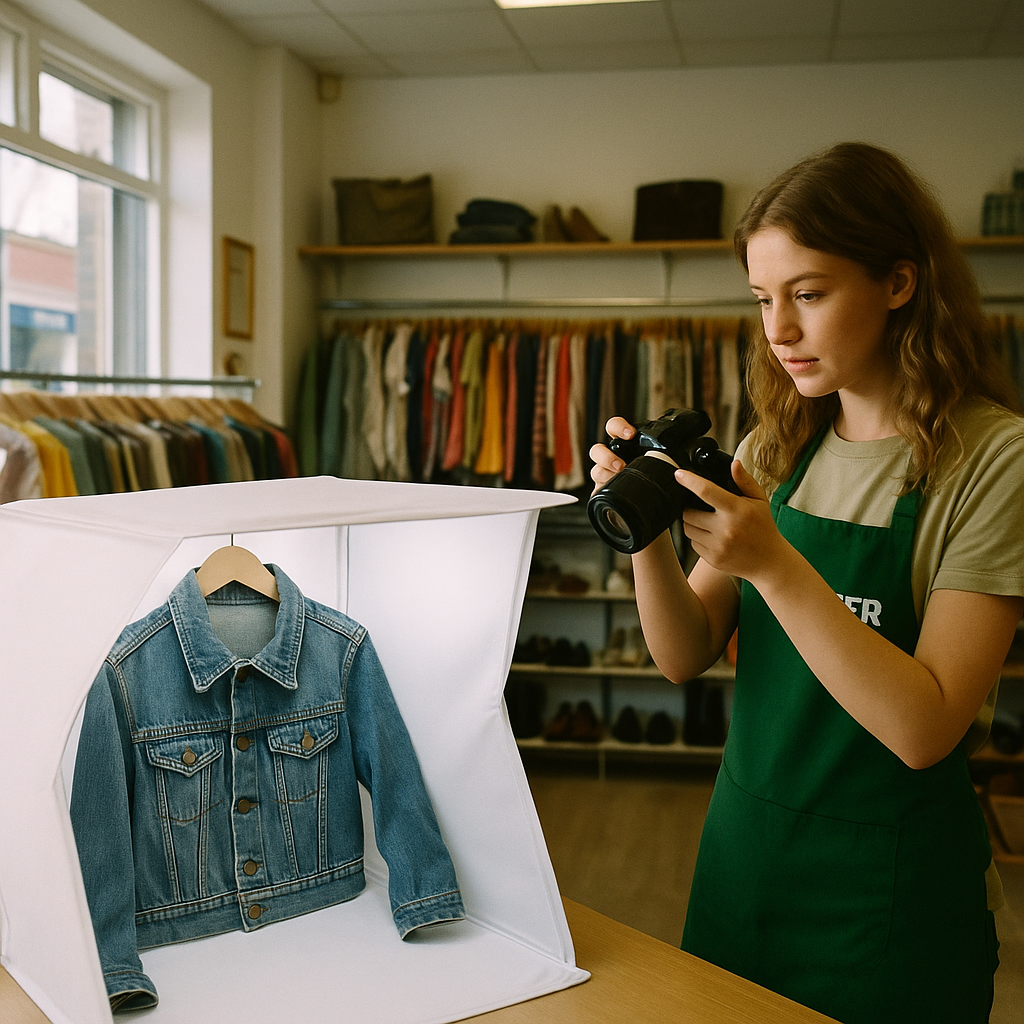
This is the bit that made me do a double-take. Oxfam has been trialling artificial intelligence tools to help volunteers price donated goods more accurately, reducing the gap between what something is listed for and what it could actually fetch on the resale market. Think: a volunteer picks up a vintage denim jacket, scans a tag or searches a description, and the system cross-references live eBay sold prices and current Vinted trends to suggest a listing price. No more tagging a rare Barbour coat at £4.99 because it smells a bit odd.
The charity has also invested heavily in centralised photography hubs, where high-value items from multiple shops are sent to be professionally photographed and listed. Buyers get clear images, accurate sizing, and honest condition notes. Hardly glamorous, but enormously effective. Conversion rates on well-photographed charity listings are significantly higher than on blurry phone snaps taken beside a donation bin.
Smaller hospice shops are finding their feet on Vinted and eBay
It’s not just the big national players cashing in. Local hospice shops and smaller regional charities have been quietly building presences on Vinted, the Lithuanian-founded secondhand fashion platform that now has millions of UK users. Unlike eBay, Vinted charges buyers rather than sellers, which makes it particularly attractive for charities trying to maximise what they keep from each sale.
St Helena Hospice in Colchester and Phyllis Tuckwell Hospice Care in Surrey are among the organisations that have set up verified charity accounts on resale platforms, reaching buyers who’d never set foot in their physical shops. For a hospice with ten or fifteen shops across a county, that’s a genuinely significant audience expansion. A vintage blouse that might sit on a Farnham rail for three weeks can sell within hours to a buyer in Leeds who found it via a Vinted search.
The logistics side is where things get interesting. Royal Mail’s Click & Drop system has become a genuine backbone for smaller charity e-commerce operations, letting volunteers print labels from donated laptops without needing any specialist kit. Low overhead, low faff. It’s democratised online selling in a way that would have been genuinely difficult a decade ago.
Why this matters beyond just raising cash
There’s a broader story here about circularity and waste. The UK sends roughly 300,000 tonnes of clothing to landfill every year, according to figures cited by WRAP, the not-for-profit that works with government and industry on waste reduction. Charity shops have always been a frontline defence against that, but their capacity was traditionally limited by footfall and shelf space. Online selling blows both constraints open. A shop in Shrewsbury can now reach a specialist buyer in Brighton who collects 1970s hiking gear. Items that would have lingered or been recycled find proper homes.
There’s also a staff and volunteer engagement angle. Younger volunteers, in particular, are far more likely to find charity retail genuinely interesting if they’re photographing vintage finds and writing eBay listings than if they’re just sorting black bin bags for six hours. Several charities have told the sector press that digital operations have actually helped with volunteer recruitment among under-35s.
What UK charity shops selling online in 2026 still get wrong
It’s not all a frictionless success story. Pricing inconsistency remains a persistent problem. The same model of vintage camera might be listed at £12 in one charity’s eBay shop and £65 in another’s, depending entirely on which volunteer did the research. AI tools help, but they’re not yet universally adopted across the sector.
Returns are another headache. Charity shops operate with minimal admin resource, and handling a return from a buyer who claims a dress isn’t the right shade of green is a very different logistical challenge from a commercial retailer. Most smaller operations handle it graciously, but it adds pressure to volunteers who are already giving their time for free.
Postage costs can also eat into margins on lower-value items. A paperback listed for £2.50 with £2.85 Royal Mail postage is barely worth the effort, and savvy shops are learning to focus their online energy on items where the margin genuinely justifies the work. Curation, not volume, seems to be the emerging philosophy.
Where this goes next
The trajectory feels pretty clear. More AI-assisted pricing, more dedicated photography facilities, more partnerships with platforms like Vinted and Depop that have younger audiences baked in. Some larger charities are exploring their own apps and direct-to-consumer subscription boxes (a curated box of vintage finds, for instance). Whether that works at scale remains to be seen.
What’s undeniable is that the sector is thinking commercially in a way it wasn’t five years ago, and the causes that depend on that income are better off for it. The bread maker on the shelf might still be priced by gut instinct. The 1960s wool coat next to it almost certainly isn’t.
Frequently Asked Questions
Which UK charity shops sell the most online?
Oxfam is widely considered the largest charity eBay seller in the UK, with dedicated online hubs and centralised photography operations. British Heart Foundation and Cancer Research UK also run significant online operations across eBay and their own websites.
Do charity shops use Vinted in the UK?
Yes, an increasing number of UK hospice and regional charity shops have set up verified seller accounts on Vinted, which charges buyers rather than sellers, making it financially attractive for charities. Smaller shops tend to find it easier to manage than a full eBay operation.
How do charity shops price items for selling online in 2026?
Many larger charities are now using AI-assisted pricing tools that cross-reference live sold prices on eBay and Vinted to suggest accurate listing values. Smaller shops often rely on volunteer research or sector guidance, though inconsistency across organisations remains a known issue.
Can I donate items specifically for a charity to sell online?
Most charity shops will accept donations for online selling alongside in-store stock, though you’d need to check with your local branch. Higher-value or specialist items (vintage clothing, rare books, electronics) are most likely to be routed to online listings.
Do charity shops make good money from eBay and Vinted?
Yes, the margins on high-value items sold online can significantly exceed what the same item would fetch in-store. Oxfam has reported double-digit year-on-year growth in online sales, and the Charity Retail Association notes online channels are an increasingly important revenue stream across the sector.
Leave a Reply