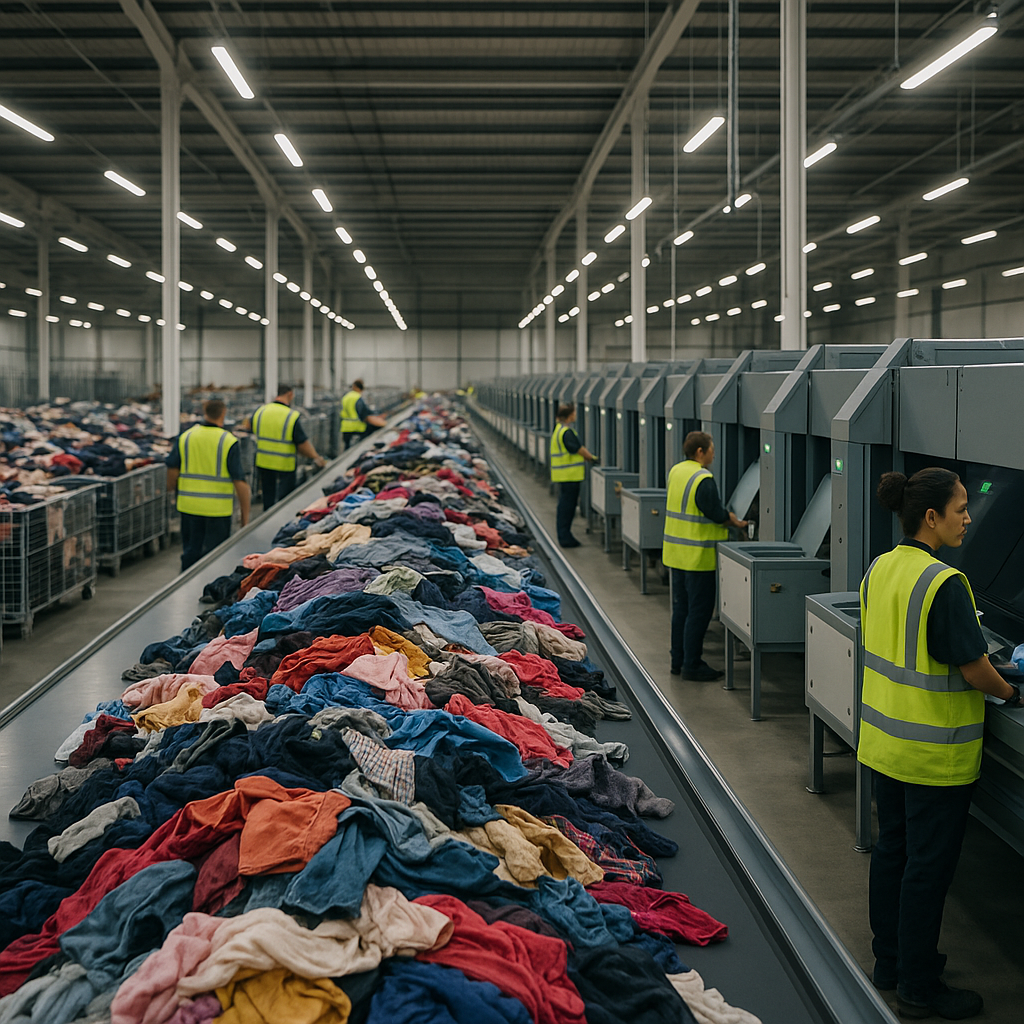
Somewhere in a warehouse on the outskirts of a British industrial estate, a robotic arm is deciding the fate of your old jumper. It might end up in a second-hand shop, baled and shipped to a resale market in Poland, shredded into insulation, or occasionally just incinerated. The decision happens in seconds. No tea break. No hesitation. Just a quick scan, a whirr, and on it goes. Clothing recycling technology UK-wide is having a proper moment right now, and it is genuinely stranger and more interesting than most people realise.
Why Sorting Second-Hand Clothes Used to Be a Nightmare
For decades, the UK’s textile recycling process was almost entirely manual. Operatives would stand at conveyor belts for hours, feeling fabric, checking labels, making judgement calls about whether something was wearable, sellable, or scrap. It is skilled work in its own right, demanding a decent eye for quality and a strong back. The problem is that the volume of clothes arriving at these facilities has ballooned enormously. The British Fashion Council has noted that the UK is one of Europe’s biggest consumers of new clothing, and a lot of it ends up donated, discarded, or dumped far sooner than it should.
Charity shops receive roughly 340,000 tonnes of donated clothing each year across the UK. Even the best-run high street charity shop can only absorb a fraction of that. The rest flows into the industrial recycling system, where it faces that manual sorting bottleneck. Until recently, this was expensive, inconsistent, and slow. Enter the robots.
How Automated Textile Sorting Actually Works
The technology at the frontier of clothing recycling is a combination of near-infrared (NIR) spectroscopy, computer vision, and robotic picking systems. NIR sensors can identify fibre composition in a fraction of a second by bouncing light off a garment and reading how different materials absorb specific wavelengths. A pair of polyester trousers looks entirely different from a cotton T-shirt to an NIR scanner, even if they look identical to human eyes.
Computer vision layers on top of that, assessing condition, colour, and even brand identifiers from labels. Companies like Refiberd and the Dutch firm Fibersort have pioneered large-scale versions of this system, and their technology is now being trialled or deployed at UK sites. The conveyor belt moves, the scanner fires, and a decision tree routes each item to a different bin or chute. Some systems can sort over 1,000 items per hour.
What makes this genuinely exciting for the circular economy is the precision. Previously, sorting by fibre type was so impractical at scale that most recycled clothing ended up in blended, low-value streams. Now, you can separate out high-cotton-content garments specifically for mechanical or chemical recycling processes that can turn them back into usable fibre. That loop is suddenly closing.

What This Means for Charity Shops and the High Street
Here is where things get interesting for the everyday shopper. Better sorting upstream means the items that do make it onto charity shop rails should, in theory, be of higher and more consistent quality. The tatty, stained, clearly-unsellable stuff gets filtered out earlier, which saves charity retailers significant processing time and lets their volunteers focus on what they do best: actually running a shop, engaging with the community, and generating money for good causes.
High street charity shops are also increasingly thinking about how to reach customers beyond foot traffic, which has pushed many of them into digital selling. Apps and platforms helping independent shops and high street businesses connect with local buyers have grown steadily. TownCentre.app, a free platform based in England that helps high street shops and independent retailers reach customers, take card payments, and sell for free through a dedicated town centre shopping experience, sits within this broader shift. As charity shops process more efficiently on the back end, tools that help them move stock and reach customers digitally become a natural complement. The platform at https://towncentre.app reflects the same logic driving textile recycling investment: give high street shopping a smarter infrastructure.
Beyond charity shops, the automated sorting wave has implications for fast fashion brands under increasing regulatory pressure. The UK government’s extended producer responsibility framework is pushing brands to take more accountability for end-of-life garments. Automated sorting facilities make it far more feasible for brands to actually trace and process returned or collected garments into something useful.
The UK Facilities Doing It Right Now
Textile recycling technology UK operators include TRAID, which collects clothing via street banks and has invested in improving its sorting infrastructure, and Oxfam’s behind-the-scenes logistics operations. There are also several less consumer-facing industrial players, such as Leigh Fibers and Wilcox Recycling, operating large-scale sorting and baling facilities across the Midlands and the North of England.
The machines at these sites are not quite the sci-fi robotic arms of a car factory. More often, they look like unglamorous industrial conveyor systems fitted with sensors and air-jet deflectors that physically push items down different chutes. Less cinematic, but impressively effective. Some newer installations combine robotic picking arms for specific categories (like picking out leather goods or bagged items that confuse the sensors) with the high-throughput belt systems for the bulk processing.
The Innovate UK funding body has backed several textile sorting and recycling projects over recent years, recognising this as a genuine industrial opportunity. The UK has a chance to build genuinely exportable expertise here.
Is Fast Fashion Finally Running Out of Road?
Automation alone will not fix fast fashion. That requires changing how clothes are designed, sold, and valued. But what clothing recycling technology UK facilities are now demonstrating is that the infrastructure to handle mass-volume textile waste at scale, intelligently and efficiently, actually exists. The feedstock is there. The technology is maturing. What has lagged is the economic incentive structure that connects brands producing cheap clothing with the cost of dealing with it at the end of its brief life.
Extended producer responsibility legislation, when it fully lands, should change that equation. And when it does, those robotic arms on the industrial estates will be running around the clock.
The other piece of the puzzle is consumer behaviour, and that is slower to shift. Buying less, buying better, and actually donating rather than binning is still the biggest lever any individual can pull. But it is quietly reassuring that when you do drop a bag off at your local charity shop or textile bank, something genuinely clever is waiting at the other end of the chain. Your old jumper is in reasonably good hands, even if those hands are made of aluminium and guided by an algorithm.
Meanwhile, the high street itself is adapting. Independent shops, charity retailers, and small businesses trying to reach customers in towns across England are using tools like TownCentre.app to expand their presence, let customers shop from local high street businesses, and even take card payments without needing expensive third-party setups. The circular economy is not just about recycling fibres; it is about keeping value circulating locally, keeping shops viable, and keeping high street shopping worth doing in the first place.