Airports are strange places at the best of times. You hand over your passport, take your shoes off for no immediately obvious reason, and queue behind someone who apparently forgot they had a full bottle of shampoo in their hand luggage. Now, though, something genuinely new is happening at Heathrow and Manchester: UK airport biometric facial recognition gates are being trialled, and they are moving fast. The question is whether “fast” is the only thing that matters here.
The basic pitch is seductive. Walk up, look at a camera, walk through. No fumbling for a passport, no scrabbling around for a boarding pass, no awkward moment where the scanner decides your document is upside down. Trials at Heathrow Terminal 5 have reportedly cut individual boarding times to under ten seconds in controlled conditions. For airlines trying to get a 300-seat aircraft off the stand on time, that is genuinely meaningful. Manchester Airport has been running similar pilots through its newer self-service e-gates, and early passenger feedback has been, on the whole, pretty positive.
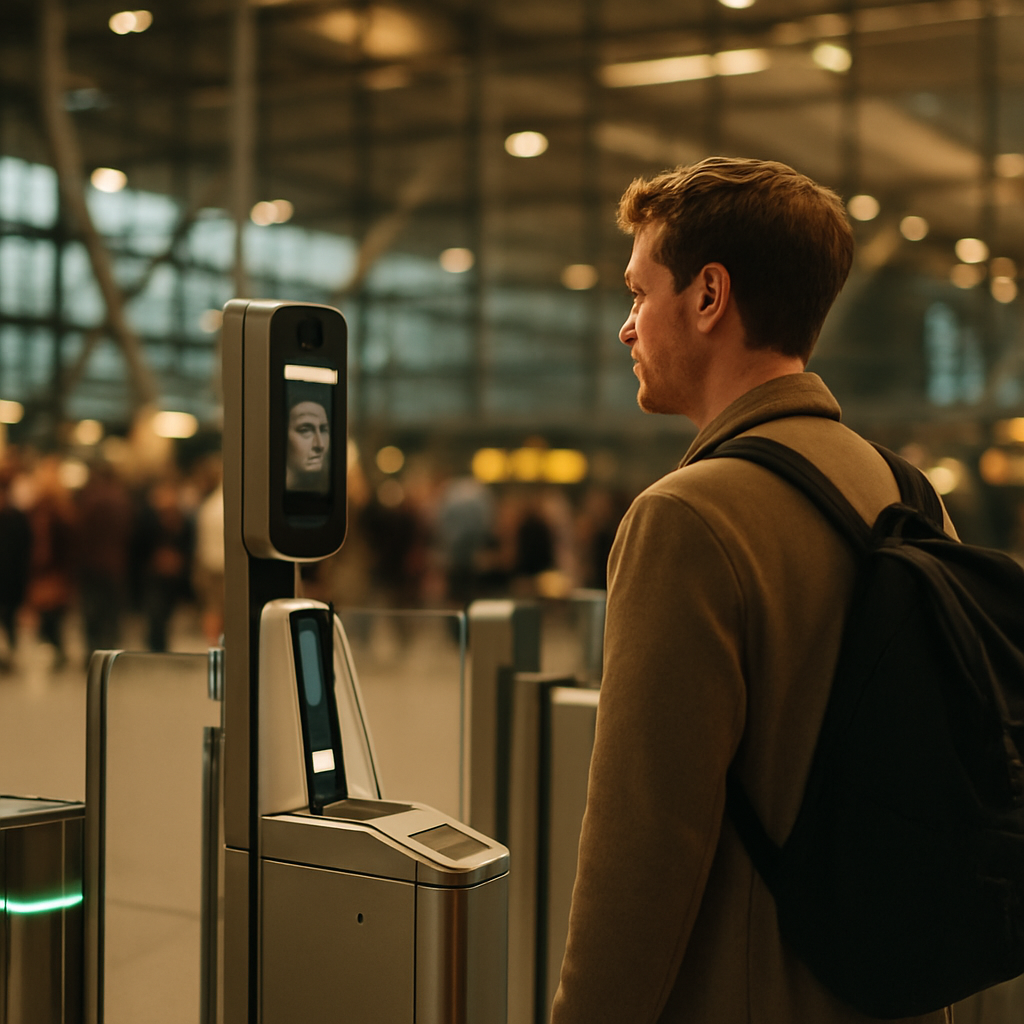
How does it actually work at the gate?
The systems being tested match a live facial scan against a biometric template stored either on your passport chip or captured earlier during check-in. Your face becomes, in effect, your ticket. The camera grabs a quick image, the algorithm compares it against the stored template, a green light appears, and off you go. The whole thing happens in the background so smoothly that many passengers have reportedly not even clocked that they’ve just been through a biometric check.
That last detail is where things get interesting, because “not noticing” is precisely the kind of passive consent that privacy campaigners find troubling. Big Brother Watch, one of the more vocal civil liberties organisations in the UK, has repeatedly raised concerns about the rollout of facial recognition in public spaces. Airports are not exactly a public square, but they are spaces where people cannot simply choose to go elsewhere if they object.
What the ICO has said about passenger biometric data
The Information Commissioner’s Office, the UK’s data watchdog, has been watching the spread of biometric systems across various sectors with visible wariness. Biometric data sits in a special legal category under UK GDPR: it is classified as sensitive personal data, which means collecting and processing it requires a lawful basis that goes beyond a standard consent tick-box. The ICO published guidance making clear that organisations using facial recognition in live public-facing contexts must demonstrate that it is strictly necessary, proportionate, and that robust safeguards are in place. You can read their current position on biometric data directly at ico.org.uk.
The airports and their technology partners argue they do meet those thresholds. The facial template, they say, is deleted once you have boarded. No long-term database of passenger faces is being built. The data is used for one purpose, in one moment, and then it is gone. That is a fairly compelling technical argument. The sticking point is verification: how do passengers, or regulators, independently confirm that deletion is actually happening?
The accuracy question nobody wants to answer directly
Facial recognition accuracy is not a flat number. It varies depending on lighting, camera quality, the algorithm being used, and critically, the demographic of the person being scanned. Multiple academic studies and real-world deployments have shown higher error rates for people with darker skin tones, older faces, and women in certain conditions. The Metropolitan Police’s own use of live facial recognition has been the subject of sustained criticism on exactly these grounds.
Airport operators have not been particularly forthcoming about publishing granular accuracy data broken down by demographic. That is understandable from a commercial confidentiality angle, but it does not sit comfortably alongside public assurances that the technology works well for everyone. If a gate wrongly rejects you five times at 6am before a long-haul flight, “it works most of the time” is cold comfort.
There is also the question of what happens at the edges. Most trials have a human agent available to handle exceptions. But as systems scale and staff numbers are squeezed (as they perpetually are in the aviation industry), that human fallback may quietly erode. The system designed as a helpful shortcut can become the only route available.
Could you opt out if you wanted to?
Technically, yes, for now. Passengers at the current trial gates can request to be processed through a standard manual check. In practice, though, the path of least resistance is always the biometric gate, and airports are not exactly incentivised to advertise the alternative. As these gates move from trial to standard infrastructure, the opt-out option may become harder to find and socially more awkward to exercise. Standing in a separate queue while everyone else breezes through a camera is a mild form of pressure, but it is pressure nonetheless.
There is a broader philosophical dimension here too. The normalisation of having your face scanned as a routine part of travel feels like a significant cultural shift. A generation of passengers who grow up expecting to look at a camera to board a plane may not question, or even register, that the same infrastructure could be used for other purposes by other actors in different contexts.
Is faster boarding worth it?
On a purely operational level, the efficiency case for UK airport biometric facial recognition is solid. Airlines lose enormous amounts of money to delays, and shaving time off boarding is one of the few levers airports can actually pull. Heathrow, handling around 80 million passengers a year, stands to gain significantly if its gates flow even marginally faster. The technology, deployed thoughtfully, genuinely could make flying less of a teeth-grinding experience.
The campaigners are not wrong, though. The ICO is not wrong. The questions about demographic accuracy, genuine consent, data retention, and the creeping normalisation of biometric surveillance in everyday life deserve proper public debate rather than being quietly resolved in the background while everyone is distracted by Pret queues and duty-free perfume. Speed is great. Transparency would be better.
What makes the UK airport biometric facial recognition story worth following is that it is one of those moments where a genuinely useful technology and legitimate civil liberties concerns collide head-on. The outcome of these trials will shape how millions of British passengers interact with airports for decades. That feels like it deserves a bit more scrutiny than it is currently getting.